
Cost-Benefit Analysis: Prefabricated Structures vs. Traditional Building in Post-War Reconstruction
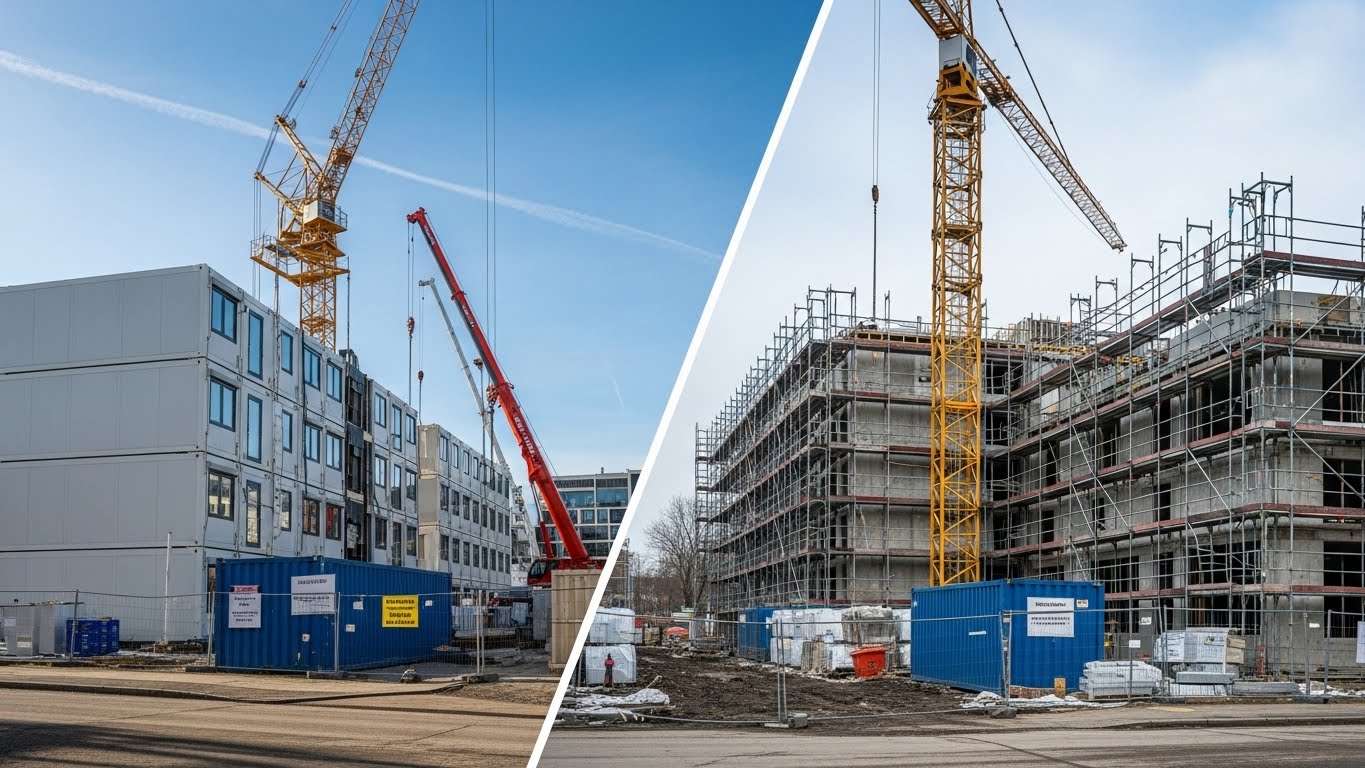
Post war reconstruction is a race against time, funding constraints, and operational risk. The real question is rarely “which method is better” in general. It is which method delivers safe, code compliant buildings at scale, with the least schedule uncertainty, the lowest lifecycle cost, and the fastest return to normal life. Prefabricated construction, including modular buildings, panelized systems, and container based solutions, often outperforms traditional site built construction in post war contexts because it transfers risk away from unstable sites into controlled production, and it compresses schedules in a way that changes total project economics.
What Is a Cost-Benefit Analysis in Post-War Reconstruction?
A reconstruction cost benefit analysis compares two delivery pathways across the full project lifecycle, not just the contract price. In post war environments, the major cost drivers are usually not only concrete, steel, or finishes. They are access restrictions, security, disrupted supply chains, labor availability, weather exposure, rework, and delays caused by permitting and utilities.
A practical cost benefit comparison should consider:
- Direct cost: materials, labor, equipment, transport, installation
- Indirect cost: security, site management, supervision, temporary facilities, insurance
- Time value: earlier occupancy, earlier service restoration, reduced humanitarian spending
- Quality and rework: defect rates, commissioning issues, spare parts, maintenance burden
- Lifecycle cost: energy use, durability, corrosion, envelope performance, refurbishment cycles
- Scalability: ability to repeat and expand without redesign and retraining
In post war reconstruction, time and predictability often carry higher economic value than the lowest upfront price.
Advantages
Prefabricated systems deliver benefits that show up clearly when you model cost and risk under post war constraints.
- Schedule compression and earlier occupancy
When buildings can be manufactured while site preparation is still ongoing, the overall timeline shortens materially. Shorter timelines reduce site overheads, security costs, and exposure to disruption. Earlier occupancy also reduces the ongoing cost of temporary shelter, emergency clinics, and fragmented services. - Higher cost certainty
Factory production stabilizes labor productivity and reduces weather downtime. This lowers variance and contingency requirements. In many post war projects, the budget problem is not only cost but unpredictability. Prefabrication improves predictability. - Lower site labor and safer execution
Traditional construction is labor intensive on site. Post war areas often have workforce shortages, safety risks, and limited skilled trades. Prefabrication shifts hours off site, reducing site labor, accommodation, security exposure, and supervision load. - Quality consistency and reduced rework
Controlled production improves tolerances, repeatability, and QA processes. Rework is one of the hidden cost multipliers in fragile environments where replacement materials, tools, and expertise are hard to mobilize quickly. - Logistics efficiency
Prefabrication enables planning around transport formats such as flat pack panels, containerized shipments, or volumetric modules. This matters when routes are constrained and border processes are slow. The ability to deliver standardized kits with a clear bill of materials reduces losses and site confusion. - Energy performance and lifecycle savings
Post war reconstruction frequently faces energy scarcity and high operating costs. Prefabricated envelopes can be engineered for high insulation, airtightness, and reduced thermal bridging, lowering heating and cooling demand and improving occupant health outcomes. - Where traditional construction can still be competitive
Traditional methods may be cost effective when the site is stable, skilled labor is available, materials are locally abundant, and schedules are flexible. It can also be advantageous for unique one off structures or complex foundations where modularization yields limited gains. In post war settings, these conditions are less common, but they do exist in certain stabilized zones.
Usage Areas
The best approach in post war reconstruction is rarely one method only. It is a portfolio strategy where each building type uses the most suitable system.
- Rapid reinstatement of essential services
Clinics, triage centers, laboratories, pharmacies
Schools, classrooms, vocational training units
Municipal offices, police and coordination buildings
Utility support buildings for power, water, and telecom - Large scale housing and community recovery
Transitional housing villages designed for phased upgrades
Permanent modular housing blocks with repeatable floorplans
Mixed use community hubs combining health, education, and admin - Camp infrastructure and life support
Sanitary blocks, shower and WC containers, laundries
Kitchens, dining halls, warehouses, cold storage
Staff accommodation for healthcare and aid workers - Industrial and logistics backbone for reconstruction
Workforce accommodation for reconstruction contractors
Workshops, maintenance buildings, depots and storage yards
In practice, prefabricated solutions typically lead in the categories where repetition, speed, and controlled quality drive value.
Dorce’s Difference
Dorce approaches post war reconstruction as an integrated delivery problem, not a product shipment. The cost benefit improves when design, manufacturing, logistics, installation sequencing, and commissioning are aligned from the start.
Industrialized production at scale
Dorce’s manufacturing driven approach supports repeatable, standardized building platforms that reduce redesign time and allow rapid multiplication of units, which is critical when rebuilding neighborhoods, service corridors, or large settlements.
Multi system capability for cost optimization
A single reconstruction program may require volumetric modules for accommodation, panelized systems for schools and clinics, and containerized units for sanitation and technical rooms. Dorce can combine these systems to match budget, transport constraints, and speed targets rather than forcing one format everywhere.
Logistics engineered delivery
In post war environments, logistics is a cost driver. Dorce designs packaging, load plans, and installation logic to reduce transport volume, simplify border processes, and accelerate on site assembly. This directly reduces indirect cost and schedule risk.
Turnkey responsibility reduces interface risk
Reconstruction projects often fail at the interfaces between designers, suppliers, installers, and operators. Dorce’s turnkey model reduces coordination overhead, improves accountability, and supports faster handover with fewer commissioning gaps.
A post war cost benefit decision is ultimately about restoring services and normal life faster, with fewer failures and a lower long term burden on public budgets and donors. By combining industrialized production with deployment focused engineering and turnkey execution, Dorce helps reconstruction stakeholders move from emergency response to stable communities with better schedule certainty, controlled total cost, and buildings that are designed to operate reliably for years.