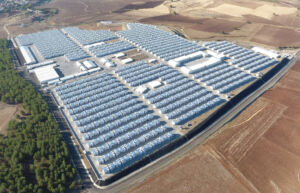
Flat-Pack Containers vs. Prefab Buildings: Choosing the Right Solution for Aid Camps
Flat-Pack Containers vs. Prefab Buildings: Choosing the Right Solution for Aid Camps
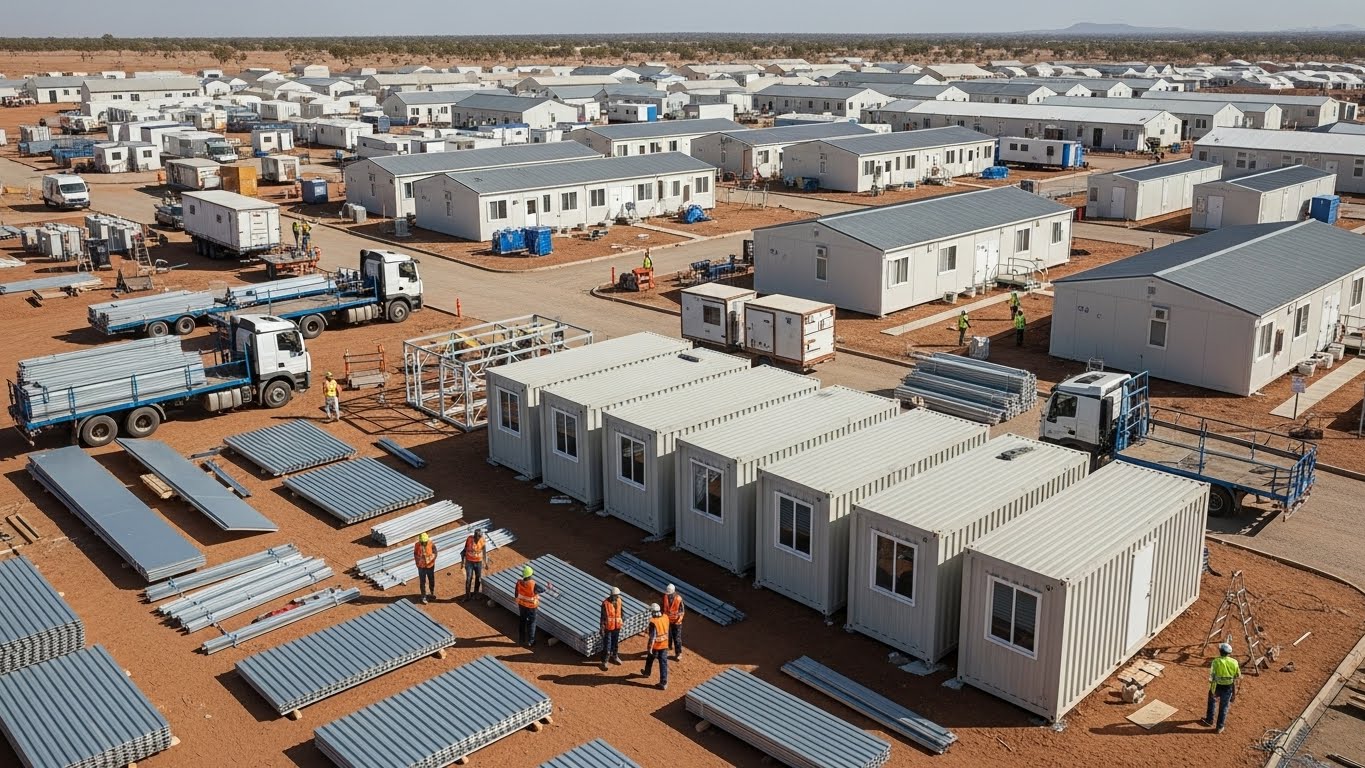
Humanitarian aid camps must be deployed fast, operate reliably, and adapt to changing conditions. Selecting the right building system is a strategic decision that directly affects logistics, speed of deployment, living conditions, and long term operability. Flat-pack containers and prefab buildings are two of the most commonly used solutions in aid camps, yet they serve different operational priorities. Understanding their strengths and limitations helps humanitarian actors choose the most effective system for each mission.
What are flat-pack containers and prefab buildings?
Flat-pack containers are modular units shipped in disassembled form. Walls, floors, roofs, and structural elements are packed compactly and assembled on site. This approach maximizes transport efficiency and is particularly effective when access routes are limited or shipping volumes must be minimized.
Prefab buildings are prefabricated structural systems produced in factories and delivered either as volumetric modules or as panelized building kits. These systems are engineered as buildings rather than containers and can include light steel or structural steel frames with higher insulation and spatial flexibility.
Both systems are offsite construction solutions, but they differ significantly in logistics behavior, assembly time, performance, and suitability for long term use.
Advantages of flat-pack containers
Transport efficiency is the most significant advantage. Flat-pack containers allow multiple units to be shipped in the space normally required for a single assembled module. This is critical in emergency responses where border crossings, ports, or road corridors are constrained.
Rapid logistics mobilization is supported by standardized packaging. Containers can be loaded onto trucks or vessels quickly, reducing handling complexity during urgent deployments.
Cost control is easier in short term scenarios. Flat-pack containers are typically faster to produce and ship, making them suitable for immediate shelter needs and rapid camp expansion.
Ease of replacement and relocation is another benefit. Units can be dismantled and redeployed to new locations as needs evolve, which is valuable in highly dynamic crisis environments.
Advantages of prefab buildings
Higher comfort and performance define prefab buildings. These systems provide better thermal insulation, acoustic performance, and internal space quality, which is essential when camps remain operational for extended periods.
Structural flexibility allows larger spans and multi room layouts. Prefab buildings can accommodate clinics, schools, kitchens, and administrative spaces more efficiently than container based units.
Durability supports long term use. Engineered prefab buildings are designed for prolonged occupancy and can transition from temporary aid camps into semi permanent or permanent settlements.
Faster commissioning on site can be achieved when modules or panels arrive with integrated finishes and MEP provisions, reducing assembly complexity for specialized facilities.
Improved social and functional layouts enhance camp livability. Wider corridors, higher ceilings, and adaptable floor plans support community functions beyond basic shelter.
Usage areas
Flat-pack containers are typically preferred for immediate emergency response, rapid shelter deployment, sanitation blocks, temporary offices, and camps where logistics constraints dominate decision making.
Prefab buildings are better suited for long duration aid camps, healthcare facilities, education buildings, kitchens, dining halls, and community infrastructure where comfort, durability, and functionality are critical.
Many large scale humanitarian operations combine both systems, using flat-pack containers for rapid initial response and prefab buildings for stabilization and long term support.
Dorce’s approach
Dorce evaluates aid camp solutions through an operational lens rather than promoting a single system. Each project begins with an assessment of access routes, deployment timelines, climate conditions, and expected duration of use.
For highly constrained logistics environments, Dorce deploys flat-pack container systems optimized for transport efficiency and rapid assembly. For longer term camps or complex facilities, prefab building systems are engineered to deliver higher comfort, durability, and spatial flexibility.
Both solutions are integrated into a unified camp master plan that includes infrastructure, circulation, sanitation, power distribution, and future expansion capability. This ensures that aid camps remain functional from the first days of deployment through extended operation periods.
Choosing between flat-pack containers and prefab buildings is not a matter of preference, but of purpose. By aligning building systems with humanitarian objectives and operational realities, Dorce enables aid camps to be deployed faster, operate more effectively, and support displaced populations with safer and more dignified living environments.