
Educational Continuity in Crisis Zones: Prefabricated Schools for Ukraine
Educational Continuity in Crisis Zones: Prefabricated Schools for Ukraine
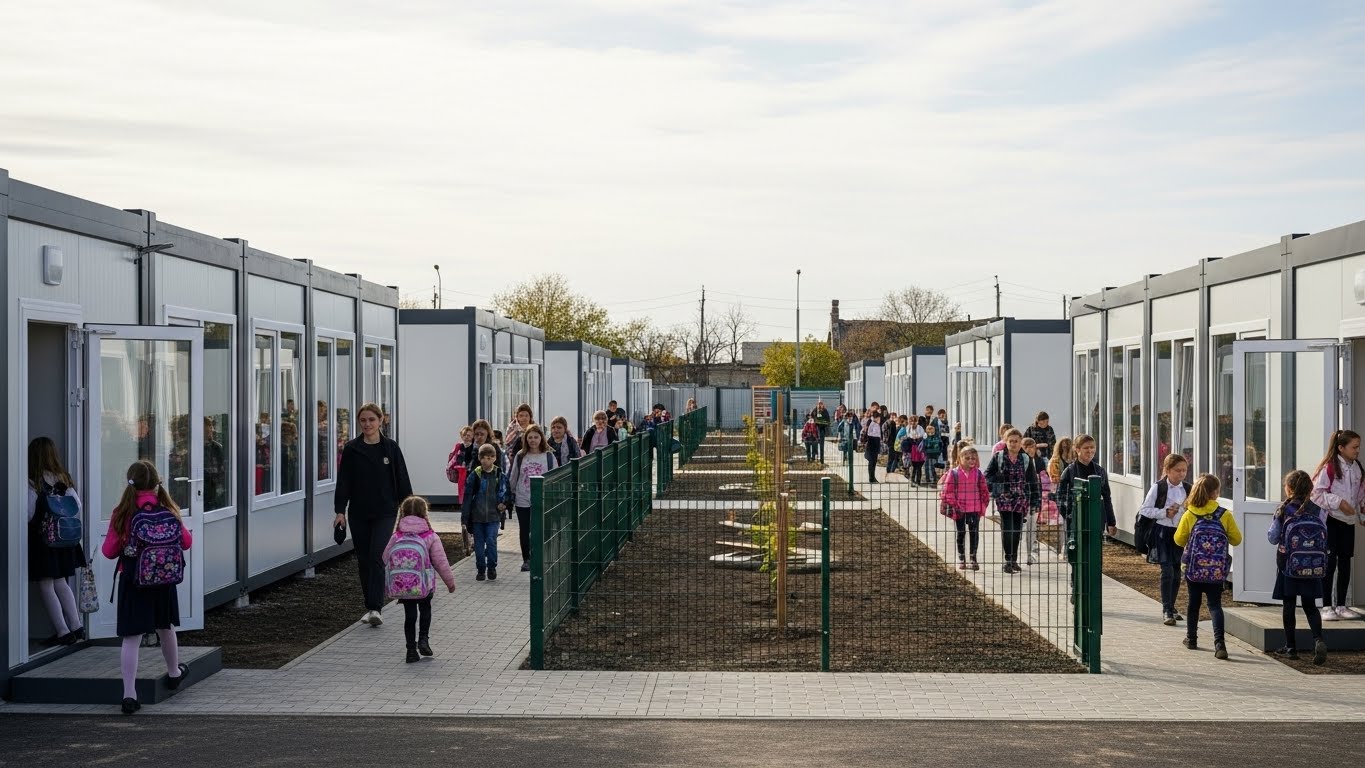
Education is one of the first public services disrupted during conflict, yet it is among the most critical to restore. In Ukraine, damaged school buildings, displacement, and safety concerns have interrupted learning for millions of children. Restoring educational continuity requires solutions that can be deployed rapidly, operate safely in harsh conditions, and remain suitable for extended use. Prefabricated schools provide a reliable pathway to reopen classrooms quickly while meeting modern educational, safety, and energy performance requirements.
What are prefabricated schools in crisis response?
Prefabricated schools are factory produced education facilities assembled on site in a short timeframe. These systems are engineered as complete learning environments rather than temporary shelters. Structural frames, insulated envelopes, classrooms, corridors, and technical systems are integrated during production to ensure immediate functionality after installation.
In crisis zones such as Ukraine, prefabricated schools serve multiple purposes. They replace damaged or destroyed buildings, provide temporary campuses during reconstruction, and support phased reopening of education in both urban and rural areas. Unlike provisional tents, modern prefabricated schools are designed for long term use, supporting stable learning conditions throughout the recovery period.
Advantages
Rapid deployment is the primary advantage. While foundations and utility connections are prepared on site, school modules are manufactured in parallel, enabling classrooms to reopen within weeks.
Safety and compliance are built into the design. Prefabricated schools are engineered to meet international building and safety standards, including fire protection, structural stability, and controlled circulation for children and staff.
Thermal comfort and energy efficiency support year round learning. High performance insulation, airtight construction, and efficient heating systems are essential in Ukraine’s cold climate, ensuring warm and comfortable classrooms during winter months.
Consistent quality is achieved through factory controlled production. Classrooms, sanitation areas, and common spaces are built to uniform standards, reducing maintenance issues and improving long term usability.
Scalability allows schools to expand as enrollment changes. Additional classrooms, laboratories, or administrative spaces can be added without disrupting ongoing education.
Durability supports prolonged use. Steel based prefabricated systems are designed to withstand intensive daily occupancy and environmental stress, making them suitable for multi year operation.
Usage areas
Prefabricated schools play a critical role across various educational needs in Ukraine.
Replacement schools in conflict affected urban districts
Temporary campuses supporting displaced students
Rural schools in areas with limited construction capacity
Educational facilities combined with community and social services
Phased school developments linked to long term urban recovery
In all cases, the ability to restore learning quickly while maintaining safety and quality is essential.
Dorce’s approach
Dorce delivers prefabricated school solutions through an integrated design and delivery model focused on speed, safety, and long term performance. Educational layouts are developed to support effective learning environments, with appropriate classroom sizes, circulation, daylight access, and acoustic comfort.
Off site production ensures precise installation of insulation, finishes, and mechanical systems under controlled conditions. Electrical, heating, and ventilation systems are integrated during manufacturing to minimize on site work and accelerate commissioning. Structural systems are engineered to withstand snow loads, wind forces, and repeated seasonal cycles.
Dorce’s experience in delivering modular education facilities in challenging environments supports rapid mobilization without compromising educational standards. Logistics and installation strategies are designed to function in areas with damaged infrastructure and limited access.
Educational continuity is a cornerstone of social recovery. Prefabricated schools enable children to return to structured learning environments quickly, restoring a sense of normalcy and stability. Through modular construction expertise and end to end delivery capability, Dorce supports Ukraine’s recovery by providing safe, energy efficient, and durable school buildings that can serve communities throughout the reconstruction process.