
Air-Transportable Modular Units: Solving Logistics in Hard-to-Reach Conflict Zones
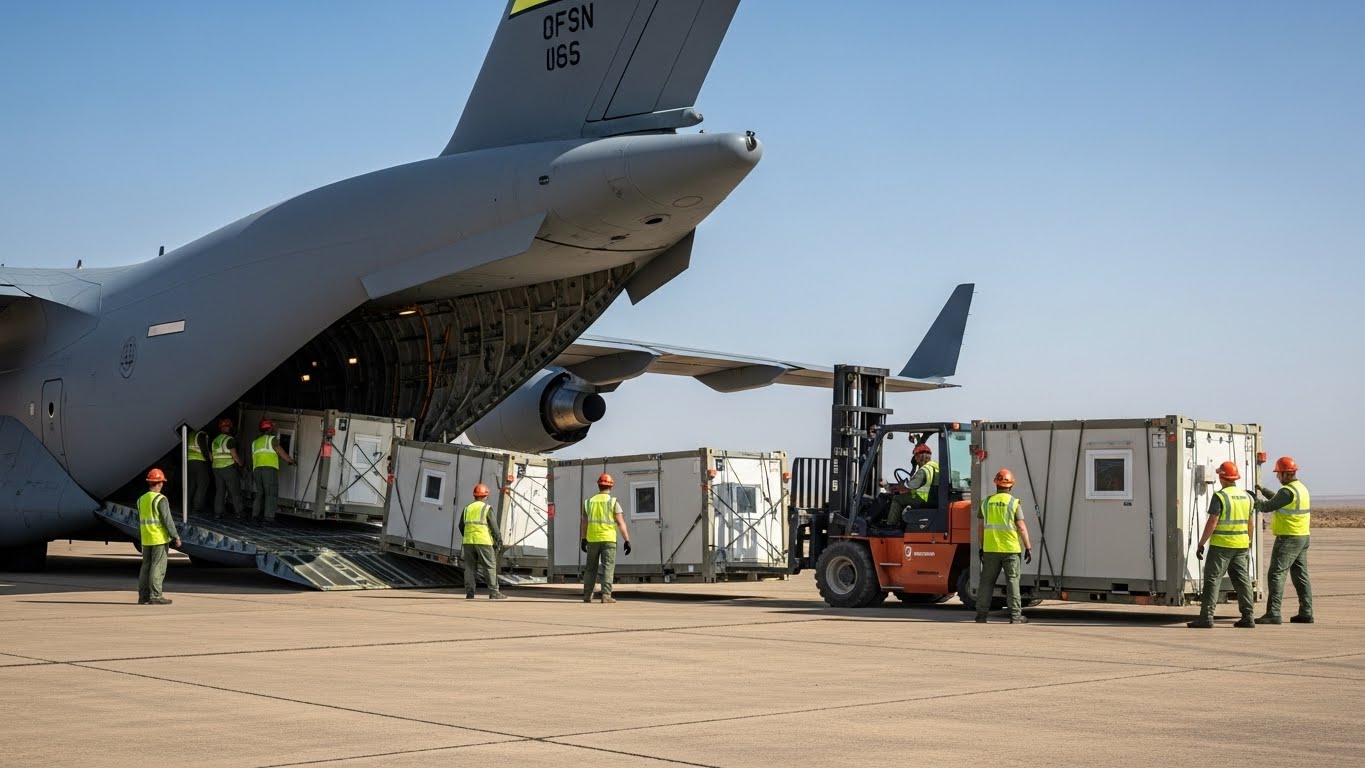
Access is one of the most decisive constraints in conflict zones. Roads may be damaged, borders restricted, ports unavailable, and ground convoys exposed to security risks. In such environments, the ability to deliver life saving infrastructure by air becomes a strategic advantage rather than a logistical alternative. Air transportable modular units address this challenge by enabling shelters, medical facilities, and support buildings to be deployed rapidly into locations where conventional construction and surface transport are impossible or too slow.
These systems are designed around aviation constraints from the outset. Weight, dimensions, packaging, and assembly logic are optimized to align with cargo aircraft capabilities, allowing critical infrastructure to reach isolated conflict zones quickly and safely.
What Are Air-Transportable Modular Units?
Air transportable modular units are prefabricated building systems engineered specifically for airlift operations. They are designed to fit within the cargo holds of military or civilian transport aircraft and to comply with strict weight and balance limitations.
Units may be delivered as flat pack components, collapsible modules, or compact containerized elements that can be rapidly assembled on site. Structural frames, wall panels, insulation, doors, windows, and internal systems are pre engineered to minimize assembly time while maintaining structural integrity and climate performance.
Once delivered, these units can be installed with minimal equipment, making them suitable for airfields, temporary landing zones, or remote sites with limited ground infrastructure.
Advantages
- Air transportable modular units provide several critical advantages in conflict and high risk environments.
- Rapid access enables infrastructure to reach locations that are otherwise cut off. Airlift bypasses damaged roads, blockades, and terrain barriers.
- Speed of deployment is significantly reduced. Units can be operational within hours or days of arrival, supporting immediate humanitarian or operational needs.
- Security risk is lowered by reducing reliance on long ground convoys that may be exposed to attack or delay.
- Operational flexibility allows units to be redeployed, relocated, or expanded as conditions change. This is especially important in fluid conflict environments.
- Precision delivery supports targeted response. Critical facilities such as clinics or command units can be delivered exactly where needed without extensive site logistics.
- Reduced onsite requirements allow installation with small teams and limited machinery, which is vital in austere or insecure locations.
Usage Areas
Air transportable modular units are used across a wide range of conflict zone applications.
- Emergency medical units and field hospitals
- Rapid deployment shelters for displaced civilians
- Accommodation units for humanitarian and medical staff
- Command and coordination facilities
- Mobile clinics and isolation units
- Sanitary and hygiene support buildings
- Temporary education and community units
These units can operate independently or form the initial phase of larger modular settlements once ground access improves.
Dorçe’s Difference
Dorçe brings extensive experience in designing and delivering modular systems optimized for complex logistics scenarios. Drawing on decades of work in defense, humanitarian, and remote infrastructure projects, Dorçe understands that air transportability must be embedded into the engineering process, not treated as an afterthought.
Dorçe’s air transportable modular units are designed with optimized weight distribution, aviation compliant dimensions, and rapid assembly logic. High performance insulation, robust structural systems, and factory integrated electrical and sanitary provisions ensure that speed does not come at the expense of durability or safety.
By managing design, engineering, manufacturing, logistics planning, installation, and commissioning under a single integrated model, Dorçe ensures reliability in missions where margins for error are minimal. Coordination with airlift operators, humanitarian agencies, and field teams allows units to move seamlessly from aircraft to operational use.
In hard to reach conflict zones, logistics often define what is possible. Through air transportable modular units, Dorçe enables humanitarian and operational teams to overcome access barriers and deliver safe, functional, and resilient infrastructure exactly where it is needed, when it is needed most.