
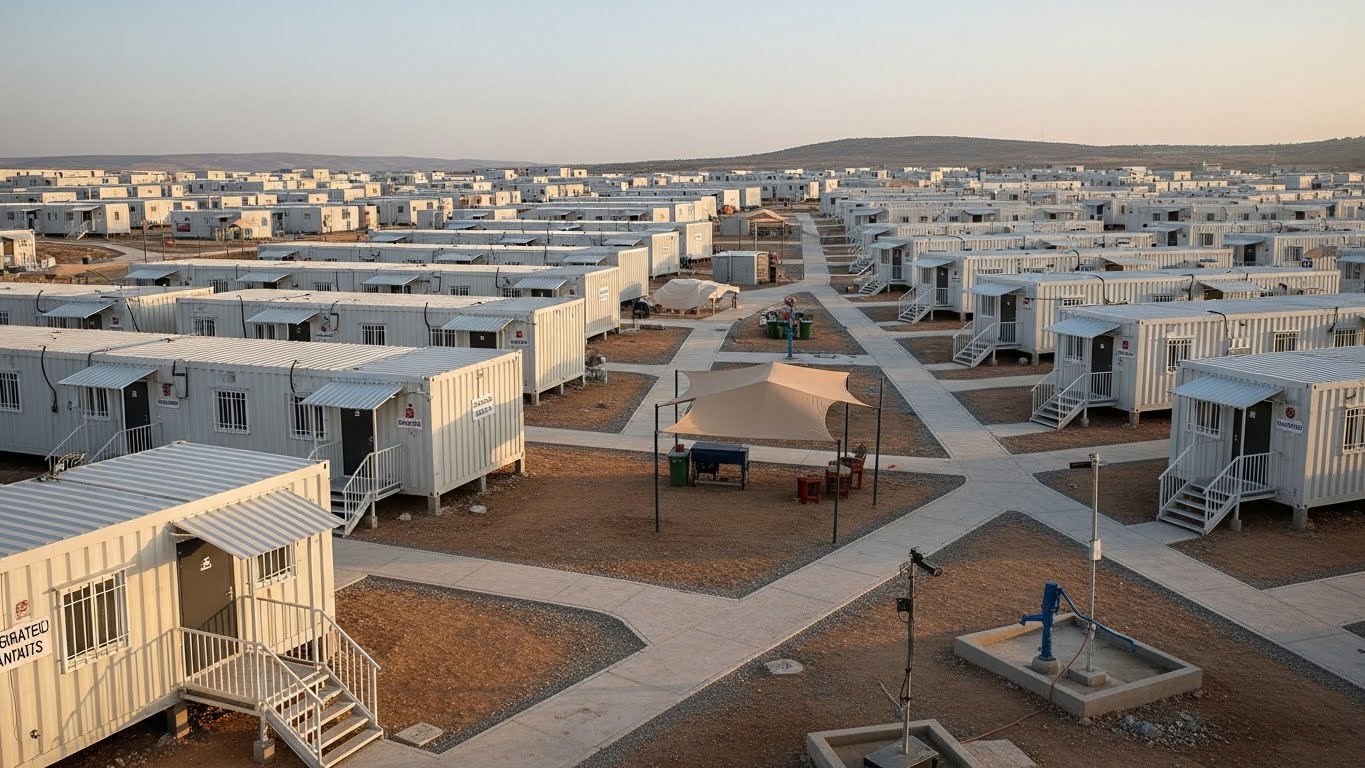
Cross border humanitarian support into Northern Syria requires construction solutions that can move quickly across borders, adapt to unstable conditions, and remain operational in environments with limited infrastructure. Prolonged displacement, seasonal climate extremes, and restricted access routes have transformed emergency shelter needs into a long term challenge. In this context, rapid housing units based on modular and prefabricated construction provide a practical and scalable response that supports both immediate humanitarian relief and sustained community stability.
Traditional shelter approaches struggle to meet these requirements due to long build times, inconsistent quality, and high maintenance needs. Rapid housing units, produced off site and delivered as ready to install systems, enable humanitarian actors to respond faster while maintaining predictable performance and compliance with international standards.
What Is Cross-Border Rapid Housing Support?
Cross border rapid housing support refers to the delivery of prefabricated and modular housing units from manufacturing locations outside the crisis zone into affected regions through coordinated humanitarian corridors. These housing units are designed to be transported efficiently, installed quickly, and occupied immediately upon deployment.
For Northern Syria, this approach allows shelters to bypass local production limitations and security risks. Housing units are manufactured in controlled factory environments, packaged for efficient transport, and deployed in phased sequences aligned with access windows. This method reduces dependency on local supply chains while ensuring consistent quality and faster delivery.
Advantages
- Rapid housing units offer sector specific advantages that are particularly critical in cross border humanitarian operations.
- Speed of deployment is achieved through parallel production and site preparation. Units can be installed within days of arrival, reducing exposure to harsh weather and unsafe living conditions.
- Logistical efficiency is supported by standardized dimensions, flat pack options, and containerized transport formats that optimize border crossings and reduce shipment volume.
- Durability and climate performance ensure shelters remain functional throughout seasonal extremes. Insulated wall systems and robust structural frames provide protection against heat, cold, wind, and dust.
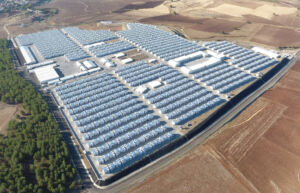
- Scalability allows settlements to expand progressively. Additional housing units can be added without disrupting existing communities or infrastructure.
- Operational predictability improves coordination with humanitarian agencies. Clear delivery schedules and standardized installation processes reduce uncertainty in high pressure response environments.
- Reduced on site labor minimizes safety risks and accelerates commissioning in areas with limited skilled workforce availability.
Usage Areas
Rapid housing units deployed into Northern Syria support a wide range of humanitarian needs.
- Family housing units for displaced populations
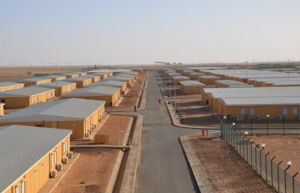
- Transitional settlements replacing tent based camps
- Accommodation for vulnerable groups including elderly and children
- Housing for humanitarian and medical staff
- Support buildings integrated into housing clusters such as community rooms
- Temporary housing supporting return and resettlement initiatives
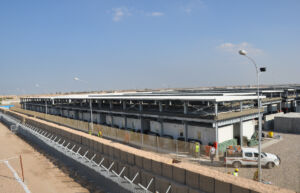
These units can be deployed as standalone shelters or organized into structured settlements with shared services, improving safety, circulation, and overall living conditions.
Dorçe’s Difference
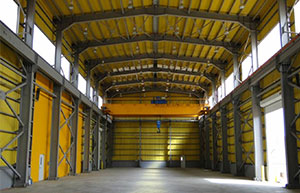
Dorçe brings extensive experience in cross border humanitarian housing delivery, supported by strong manufacturing capacity and international logistics expertise. With a background in large scale camps, modular housing, and crisis response projects, Dorçe understands the complexity of delivering housing units across borders under time and access constraints.
Dorçe’s rapid housing units are engineered for fast installation, durability, and low maintenance. Factory integrated electrical and sanitary systems reduce on site work and ensure immediate usability. Housing layouts are designed to support family needs while allowing flexible settlement planning and future expansion.
By managing design, engineering, manufacturing, logistics, installation, and commissioning within a single integrated delivery model, Dorçe provides reliability and accountability throughout the humanitarian response chain. This approach reduces coordination risk and ensures that housing units arrive ready to serve displaced communities without delay.
Cross border humanitarian support is not only about moving materials. It is about delivering safe and dignified living environments where people can regain stability amid uncertainty. Through rapid housing units for Northern Syria, Dorçe supports humanitarian organizations by providing scalable, resilient, and efficient shelter solutions that respond immediately to urgent needs while laying the groundwork for longer term recovery.