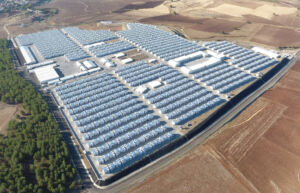
From Factory to Field: The Supply Chain of Emergency Settlement Units
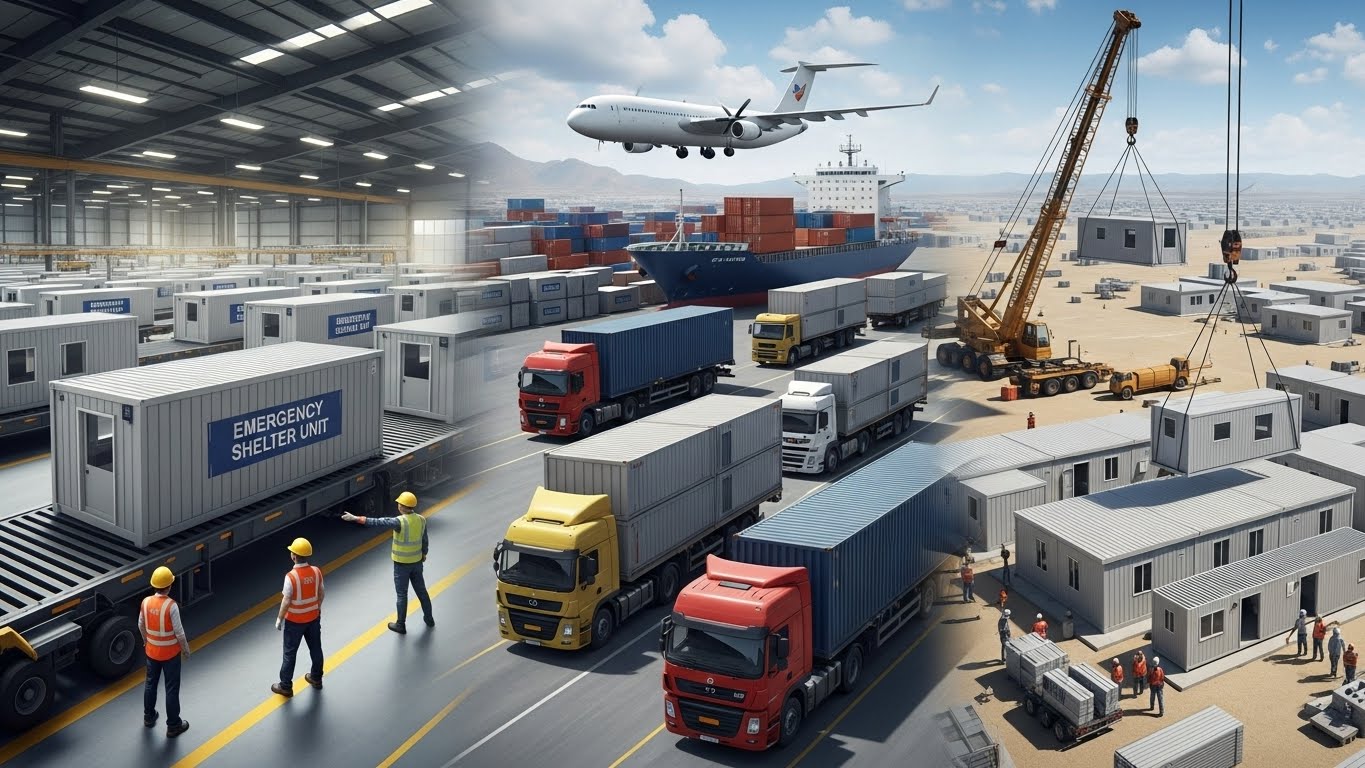
In emergency response, the effectiveness of shelter solutions is defined not only by design quality but by how efficiently they move from production to deployment. Emergency settlement units must travel through complex supply chains under extreme time pressure, unstable access conditions, and limited infrastructure. The journey from factory to field is therefore a critical process that determines whether shelters arrive on time, function as intended, and provide immediate relief to affected populations. A well structured supply chain transforms modular construction into a true life saving capability.
Unlike conventional construction, emergency settlement delivery relies on industrialized production and logistics driven planning. Every decision, from module dimensions to packaging method, is made with transportation, handling, and rapid installation in mind. This integrated approach allows emergency settlements to be activated quickly and reliably even in the most challenging environments.
What Is the Emergency Settlement Supply Chain?
The emergency settlement supply chain refers to the end to end process of planning, manufacturing, transporting, installing, and commissioning prefabricated shelter systems for crisis response. It begins with standardized design and industrial production and continues through international logistics, border clearance, site delivery, and on site assembly.
In this model, supply chain considerations are embedded into the engineering phase. Modules are designed around transport constraints, assembly sequences are predefined, and critical components are prioritized for phased delivery. This ensures that shelters are not only produced quickly but can also be deployed and occupied without delay.
Advantages
- An optimized supply chain delivers several decisive advantages in emergency settlement deployment.
- Speed is achieved through parallel workflows. While sites are prepared, units are manufactured and packaged, eliminating idle time between phases.
- Predictability improves coordination with humanitarian agencies and authorities. Clear timelines and standardized processes reduce uncertainty during crisis response.
- Logistics efficiency is maximized through flat pack systems, containerized transport, and optimized loading plans that increase shipment volume and reduce transport cost.
- Quality control is strengthened by factory based production and pre shipment testing, reducing failure risk in the field.
- Reduced onsite complexity minimizes installation time and safety risks, which is critical in unstable or high risk environments.
- Scalability allows settlements to expand progressively. Supply chains can be adjusted to deliver additional units or services as needs evolve.
Usage Areas
A robust emergency settlement supply chain supports a wide range of humanitarian applications.
- Rapid deployment housing for displaced populations
- Sanitary and hygiene container units
- Emergency medical and field hospital facilities
- Temporary schools and education units
- Accommodation for humanitarian and medical staff
- Administrative and coordination buildings
- Technical units for power, water, and waste systems
Each of these elements can be delivered independently or as part of a fully integrated emergency settlement.
Dorçe’s Difference
Dorçe manages the emergency settlement supply chain as a single integrated operation rather than a sequence of disconnected steps. With extensive experience in modular construction, humanitarian response, and complex logistics environments, Dorçe designs settlement units with supply chain efficiency at their core.
Manufacturing is aligned with deployment priorities, allowing critical units such as sanitation and medical facilities to be delivered first. Packaging formats are optimized for road, sea, and air transport, ensuring flexibility when access conditions change. Each unit is factory tested, labeled, and prepared for rapid installation, reducing uncertainty on site.
By controlling design, engineering, production, logistics, installation, and commissioning under one delivery model, Dorçe ensures accountability and speed from factory to field. This approach minimizes coordination risk and enables emergency settlements to become operational as soon as units arrive.
In emergency response, delays cost lives. A reliable supply chain ensures that shelter solutions move seamlessly from production lines to people in need. Through its integrated factory to field delivery model, Dorçe transforms modular construction into a responsive and dependable humanitarian tool, providing safe, functional, and timely emergency settlements when and where they are needed most.