
Scalable Emergency Housing: How to Build a Camp for 10,000 People Quickly
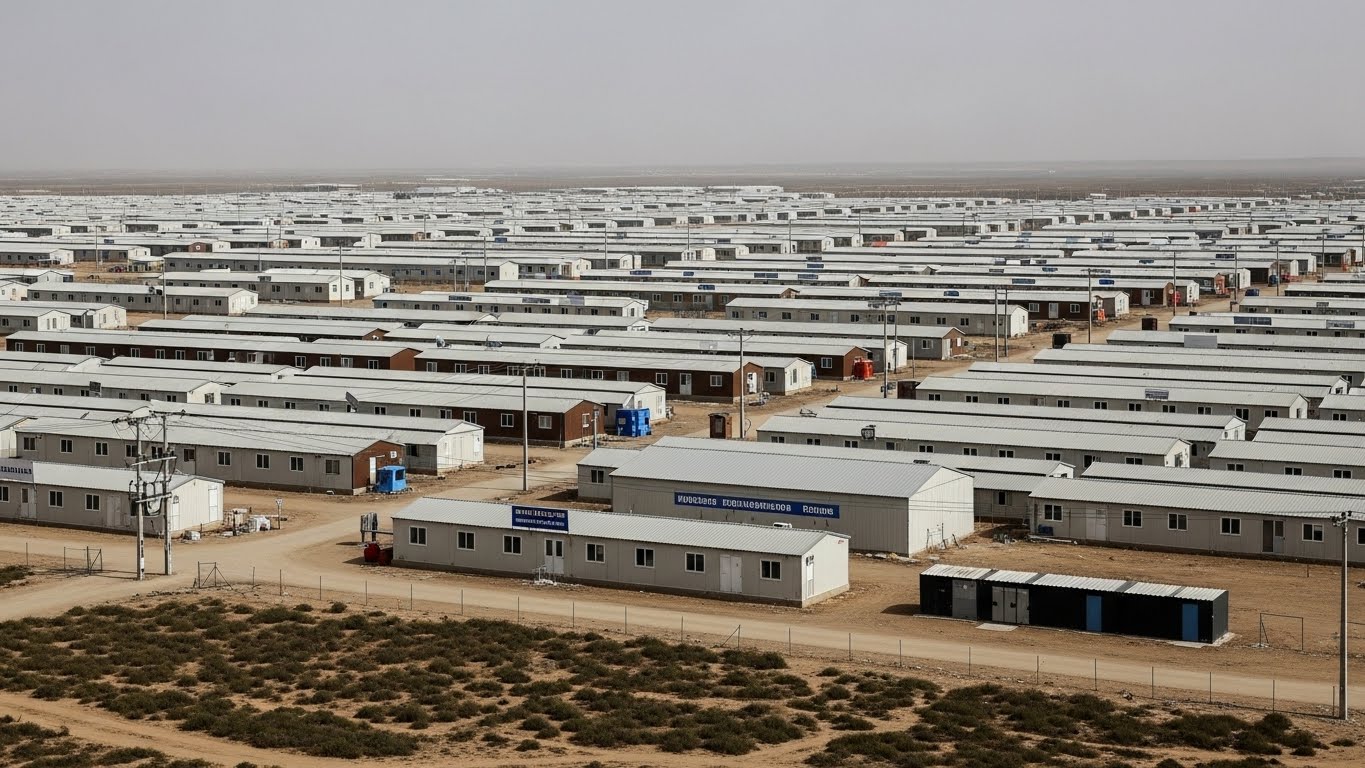
Large scale displacement requires solutions that go far beyond individual shelters. When populations reach tens of thousands, emergency housing becomes a matter of systems engineering, logistics management, and coordinated planning rather than isolated construction activities. Building a camp for 10,000 people quickly demands speed, scalability, and operational reliability, while ensuring safety, hygiene, and long term usability. Modular and prefabricated construction provides the only realistic approach to meeting these requirements under crisis conditions.
Scalable emergency housing relies on industrialized production, standardized layouts, and phased deployment strategies. Instead of treating housing as a series of standalone units, successful large camps are designed as integrated settlements where accommodation, infrastructure, and social services are deployed simultaneously and expanded progressively.
What Is Scalable Emergency Housing?
Scalable emergency housing refers to prefabricated and modular settlement systems designed to accommodate large populations through repeatable, expandable building blocks. Housing units, sanitary facilities, healthcare buildings, and support infrastructure are developed as standardized modules that can be multiplied and arranged according to population size and site conditions.
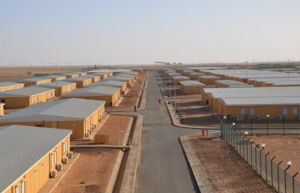
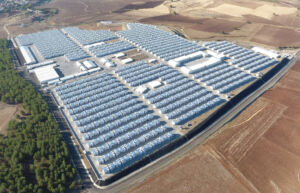
For a 10,000 person camp, scalability means that the first deployed units already follow the same logic as the final settlement. Roads, utility corridors, drainage, and zoning are planned from the outset to support expansion without disruption. Modular housing units are manufactured off site with integrated systems, enabling rapid installation and immediate occupancy.
This approach allows camps to transition smoothly from emergency response to semi permanent or long term settlements if displacement persists.
Advantages
- Scalable modular housing offers decisive advantages when building large emergency camps under time pressure.
- Speed of deployment is achieved through parallel processes. While site preparation and basic infrastructure are established, thousands of housing units and service buildings are produced simultaneously in factories.
- Population scalability allows capacity to increase in defined phases. Camps can grow from initial reception areas to full scale settlements without redesign or demolition.
- Operational efficiency is improved through standardized layouts. Repeating unit types simplify installation, maintenance, and service delivery across the entire camp.
- Infrastructure integration ensures that water, power, sanitation, and waste systems are deployed alongside housing rather than added later as emergency fixes.
- Quality consistency is maintained across thousands of units through factory controlled production, reducing variation and performance risk.
- Safety and risk management benefit from reduced onsite labor and shorter construction durations in unstable environments.
Usage Areas
Scalable emergency housing systems are used in a wide range of large scale humanitarian and crisis scenarios.
- Refugee and displacement camps exceeding 10,000 residents
- Post conflict population return and resettlement zones
- Natural disaster mass displacement response
- Cross border humanitarian reception centers
- Large workforce accommodation for emergency infrastructure recovery
- Temporary urban extensions during crisis periods
In these contexts, camps often function as full communities, requiring education, healthcare, administration, and social spaces alongside housing.
Dorçe’s Difference
Dorçe brings extensive experience in delivering large scale emergency and workforce camps for thousands of people in some of the most challenging environments worldwide. With a strong background in modular construction, humanitarian infrastructure, and logistics driven deployment, Dorçe understands how to scale emergency housing rapidly without sacrificing quality or control.
Dorçe’s approach to scalable emergency housing begins with master planning. Camp layouts are designed to support phased growth, efficient circulation, and infrastructure resilience. Modular housing units are engineered for durability, climate performance, and fast installation, while sanitary, healthcare, and service buildings are integrated into the same modular system.
By managing planning, engineering, manufacturing, logistics, installation, and commissioning under a single turnkey delivery model, Dorçe ensures coordination and accountability at every stage. This integrated approach allows camps for 10,000 people to be deployed quickly, activated progressively, and operated reliably from the first day of occupancy.
Building a camp for 10,000 people is not only a construction challenge but a humanitarian responsibility. Through scalable emergency housing solutions, Dorçe delivers structured, efficient, and resilient settlements that provide immediate protection while creating the foundation for stability, dignity, and long term recovery in crisis environments.